Photosymbiosis in marine systems
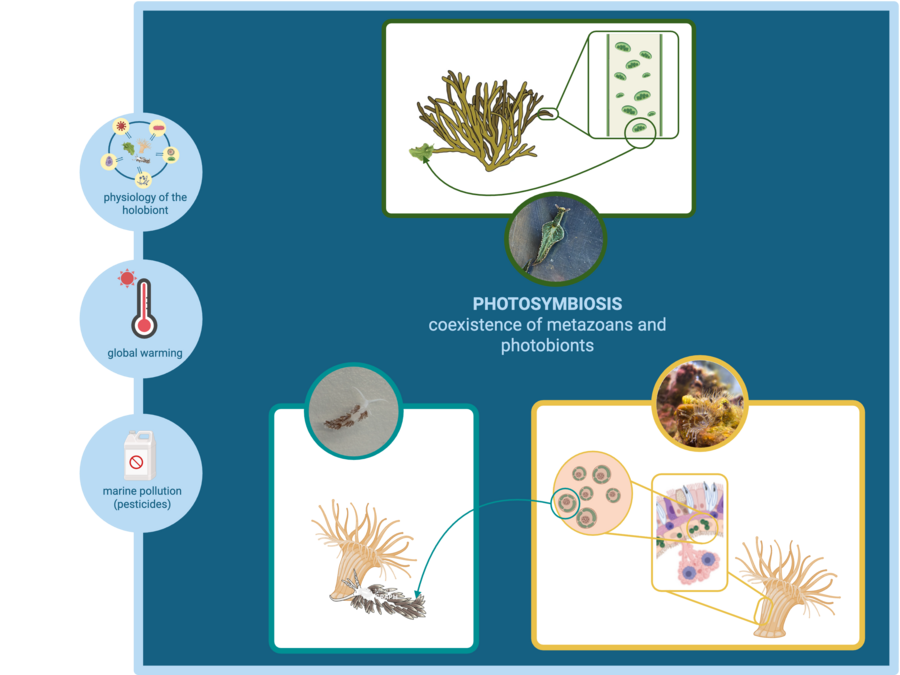
A central research focus of our group is the investigation of photosymbiosis in marine metazoan systems under different biological and environmental conditions. We investigate different forms of photosymbiotic lifestyles - from kleptoplasty, in which only photosynthetically active cell organelles are adopted, to stable endosymbiosis with unicellular algae.
Our work is based on three model organisms that represent different symbiosis strategies:
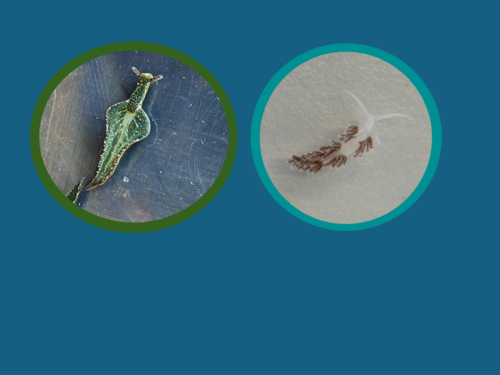
the marine snails Elysia viridis (Mollusca, Heterobranchia, Saccoglossa) and Berghia stephanieae (Mollusca, Heterobranchia, Nudibranchia), and the glass rose Exaiptasia diaphana (Cnidaria, Heyacorallia, Actiniaria).
In our projects we investigate photosymbioses in different host groups and symbiosis forms, from kleptoplasty to obligate endosymbiosis. We look at these systems from a holobiont perspective, i.e. as a functional unit consisting of host (snail, or anemone), photosymbiont (dinoflagellate, or chloroplast), and associated bacteria, archaea, fungi and viruses. A particular focus is on the interplay between host, photobiont and bacterial communities and their importance for the stability, adaptability and health of the symbiosis.
Our research is organised into three closely linked projects:
Two projects are dedicated to photosymbiosis within the Heterobranchia (marine snails) and investigate how different symbiotic partners, food sources and environmental factors influence the functionality of these systems. Another project focusses on photosymbiosis in Cnidaria, which is of central importance for reef-building corals and thus for entire reef ecosystems.
Across all projects, we are analysing the effects of anthropogenic stressors such as rising water temperatures and pesticide exposure on the stability of photosymbiosis and the holobiont as a whole. The aim is to identify fundamental mechanisms that determine the resilience or vulnerability of these systems and thus contribute to a better understanding of the adaptability of marine symbioses under global change.